Showing posts with label Mandate of Heaven. Show all posts

Friday, May 26, 2017

Mencius: Advice for the Emperor Trump and His Mandarins

In Hinton's translation of the Mencius I've gotten to chapter VII, or, Book One of Li Lou. I think it's especially apropos to what is currently happening in Washington.

Mencius starts off by emphasizing the importance of tradition to a good ruler. It isn't enough to just set out with good intentions, a ruler has to follow the "Way"---or traditions---that has been set by previous leaders. He quotes an unattributed saying:
Virtue alone isn't enough for government,
and law cannot alone put itself into action.
The point is emphasized by an analogy with skilled craftsmen. Even the best of them rely upon tools like a compass or square to draw their circles and right angles. In the same way, a leader needs to rely upon the traditions of his predecessors in order to get things done.

This can sound odd to modern people, but I'd ask readers to try to understand how a government bureaucracy works. Ultimately, it is a huge collection of people who have been hired to make sure that certain policies will be acted upon. And the problem is that getting something done is always a lot more difficult than people think. This requires expertise and myriads of individual choices being made by individual bureaucrats. And to do this, every government requires high officials who have a great deal of authority delegated to them by the sovereign. In effect, every complex society requires a class of Mandarins.
A Mandarin official, Late Qing China, by John Thomson, 1869.
c/o the Wiki Commons

"Mandarin" is the Portuguese/English word that we use to describe the scholar/officials that governed ancient China for centuries. It is also the word that Canadians routinely use to describe the higher officials in our government bureaucracy, though I've never heard an American call any of their officials "Mandarins". Donald Trump ran for office and pledged to "drain the swamp" in order to "get things done". Many people thought that the swamp he was going to drain was the influence of big money in politics, whereas it appears that what he really meant was to destroy the influence of high officials.  

A key principle of modern governance is the idea that the sovereign is not above the law. This is part of the "Way" of American society. It is the square or compass that the president is supposed to use when he is governing the nation. It is also a key principle that allows American mandarins---like FBI Director James Comey---to guide the way they do their job. That is why the President's attempt to get Comey to swear personal loyalty to him, and, his decision to fire him when he refused to take direction on the Russia file, is viewed by the law as "obstruction of justice". No one---even the President---is supposed to be able to stop an independent official from doing his job. This is especially true when the mandarin in question is a law enforcement official who is investigating claims of wrong-doing aimed specifically at the President himself.

A Modern US Mandarin, James Comey
Federal Govt Photo, c/o Wiki Commons
This principle, that the sovereign is not above the law, came about because it is the only way to stop officials from using their power to make themselves rich at the expense of the general public.

It is tremendously important for an efficiently functioning society to create institutional "firewalls" between the politicians and the bureaucracy (eg the Mandarins.) If you do not, you will have government officials "pulling strings" in order to get special favours for wealthy "friends". This is not only unfair, it damages the economic life of a society. Business people need consistency to be able to make long-term plans. And if they have no idea how to tell if something is going to be accepted by a planning commission, for example, because the issue is settled not by legal precedent but by bribing the local official---it becomes very expensive to do many types of business.

Mencius understands the importance of following the "Way" of society to the point where he suggests that it is not only necessary, it can actually be sufficient to sustain it.
If city walls are unfinished and weapons scarce, it doesn't spell disaster for the nation. If people aren't plowing new fields or piling up wealth, it doesn't spell ruin for the nation. But if a leader ignores Ritual and officials ignore learning, the people turn to banditry and rebellion, and the nation crumbles in less than a day. 
This is an important point. What is at stake in the Trump Presidency isn't the economic or military might of the United States. It isn't even it's influence on the world stage. These are ephemeral. What makes America "America" are the such esoteric principles as the rule of law instead of the sovereign. And because these only exist insofar as the bureaucracy keeps them in existence, something that keeps America being America are the Mandarins like James Comey---who refused to put loyalty to the President ahead of loyalty to the law.

&&&&

One of the memes that has been bandied about a lot recently is the existence of the "Deep State". This term was originally coined with reference to the way the military in Turkey and Egypt, as well as the Security Apparatus in Russia control the organs of government without any significant influence by elected officials. It has also been suggested that this is also happening in the USA through the machinations of what Eisenhower called "the military industrial complex". Supporters of Donald Trump are arguing that the work of the FBI, the CIA, and, the Judiciary, to investigate his administration for ties to Russia and also to block his orders banning Muslims from entering the country is evidence of the Deep State's opposition to a democratically-elected president.

This is a profound misuse of the term "Deep State". What is happening in the US is that the bureaucracy is doing its job of defining and limiting the ability of elected officials to trample over the rights of its citizens. The constitution and the traditions of the USA mean nothing if they are just words on pieces of paper. A society also has to have effective leaders who devote their lives to making sure that the spirit of the law remains enforced. Mencius said:
When all beneath Heaven abides in the Way, small Integrity serves great Integrity, and small wisdom serves great wisdom. When all beneath Heaven ignores the Way, small serves large, and weak serves strong. Either way, Heaven issues it forth---and those who abide by Heaven endure, while those who defy Heaven perish.
What he is talking about is the rule of law versus the rule of the powerful. The only defense that any society can have is the existence of honourable people who put their allegiance to what they believe is right ahead of their own personal careers. That is to say, in a large society like ours, an essential element of its defense against the abuse of power is the existence of Mandarins like Jame Comey.

&&&&

This isn't to say that the man is a saint. His behaviour during the election with regard to Hillary Clinton's emails was ridiculous. I don't know the man, so he could be totally and utterly wrong about any number of things from civil rights, the environment, to, Black Lives Matter. In fact, I suspect that he's the sort of patrician Republican that I would consider an ignorant boob if I ever met him. But within his understanding of right and wrong, he was unwilling to put his own career ahead of the constitution. As such, he did his job as a Mandarin. That is all anyone can ask of him. Being a Mandarin doesn't require any great insight into the great issues of the day, it just requires a personal commitment to the principles that sustain the nation---even at the cost of your own career. I may not particularly like the USA as it presently exists, but I have no illusions that it could not get significantly worse. I believe in the importance of change, but I want the change to be for the better.

&&&&

One last point. Once the United States loses its ability to find and appoint Mandarins to high office, it will be totally destroyed as a nation. Mencius said:
---only after a person has demeaned himself will others demean him. Only after a great family has destroyed itself will others destroy it. And only after a country has torn itself down will others tear it down. The "T"ai Chia" says:  
Ruin from Heaven
we can weather.
Ruin from ourselves
we never survive. 

If the USA cannot continue to find Mandarins of integrity (however they define it) and place them in positions of responsibility, the nation will be destroyed. It is that simple. We have to see who will win in this battle between demagoguery and integrity.

&&&&

If you enjoyed this essay, please consider tossing something in the tip jar. Even a dollar would be significant.

Walk lightly on this beautiful earth!

Sunday, February 21, 2016

Mencius and "Soft Power"

In book six ("Duke Wen of T'eng, Bk Two"), chapter 5, of the David Hinton translation of Mencius, a disciple of Mencius asks him about the limits of righteousness when it comes to asserting power in the world. He points to the small state of Sung (also translated as "Song")  "Sung is a small nation. If its government became that of a a true emperor and it were therefore invaded by Ch'i and Ch'u, what could be done?"

Remember that Mencius was writing at the time of the "Warring States" period, which was when a group of individual nations emerged from the old Zhou dynasty. Because what we now call "China" was fragmented into different states, it was a time of intense competition as various governments experimented with different philosophies in order to create the most successful society. This is when Daoism, Confucianism, Moism, Legalism and so on competed with one another in much the same way that Communism, Capitalism, Fascism, and so on vied for supremacy in the 20th century.

Warring States China:  450 BC
As you can see in the above map (click on it to get a good view), Song was one of the smaller states in this group---situated between the much larger states of "Chu" (ie: "Ch'u") to the South and "Qi" ("Ch'i") to the North . The assumption that the disciple is making is that there is nothing that the rulers of Song can do to avoid being swallowed up.

This is a significant concern for Mencius, because he posited that rulers only governed at the sufferance of their people. This is the concept of the "Mandate of Heaven", or, the idea that if a potentate was so bad that his people successfully revolted against him, the divine right by which he rules was revoked and handed to whomever replaced him. The question being raised is "what happens if a ruler with the Mandate of Heaven (ie: a "true emperor") arises in a small state like Sung? Will the mandate protect him from being squashed like a bug?"

Mencius's answer is to make an analogy from The Book of Documents, (also called The Classic of History). I've not read any of it myself, and Wikipedia says that much of it was lost during the Qin Empire's book burning that followed the end of the Warring States period, so I don't even know if there is anymore than can be learned about the incidents that Mencius refers to. But what he does say is pretty self-explanatory. The ruler of Po (T'ang) was concerned about the ruler of the neighbouring state of Ko neglecting some sacrifices. So Po sent Ko some "foreign aid" in the form of animals to be sacrificed. Instead, the rulers of Ko just ate them. Again, Po asked why the sacrifices weren't being followed, and the response was "Ko doesn't have enough millet". So Po sent some "Peace Corps" workers to help with the plowing and planting---Ko had their food and seed stolen and even killed one of the young people that was sent.

After this outrage, Po sent an army to remove the leadership of Ko. Mencius says "---everyone within the four seas said:  It isn't lust for all beneath Heaven:  it's revenge for the abuse of common men and women." Mencius then goes on to say that T'ang then went to mount eleven other expeditions to build his empire. He says that "When he marched east, the western tribes complained. And when he marched south, the northern tribes complained:  Why does he leave us for last?"

The reason why people wanted T'ang to invade them was because of the way he ruled that nations under his sway. Mencius says
People watched for him the way they watched for rain in the midst of a great drought. When he came, they went to market unhindered again and weeded their fields without interference. He punished the rulers and comforted the people, like rain falling in its season. And so a great joy rose among the people. The Book of History says:  We're waiting for our lord:  his coming will end our suffering.
In effect, when T'ang marched into another country it wasn't seen as an invasion but rather as a liberation.

What Mencius is talking about is soft power. This is when a state or institution is capable of influencing other states or institutions through example rather than by using either bribery or brute force. At one time there were countries that actively tried to use soft power in the world---Canada at one time was one of them. But after the attacks of 9/11 and other incidents of terror, a different narrative took over, one that finds appeals to reason or the better nature of other people totally inexplicable.

&&&&

Take a look at the following clip from a speech by Canada's current Prime Minister, Justin Trudeau. In it, he is outlining Canada's new policy for dealing with Isis. It involves three elements.

First, he is removing the six fighter bombers that are currently involved in attacking ISIS position. They will be replaced by some support services for the bombers being supplied by other nations such air tankers for refueling and surveillance aircraft to help identify bombing targets.

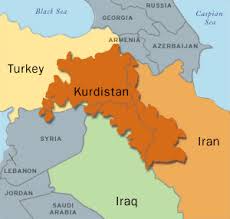
The second element involves military support for the emerging nation state of Kurdistan. This ultimately means that Canada supports the ending of the boundaries that resulted from the Sykes-Picot Agreement and the emergence of new borders that actually reflect the ethnic identity of the population.
Where the Kurds Live
In practical terms, this support involves sending more military trainers and light weapons such as assault rifles, machine guns, mortars and ammunition to help the Peshmerga with their campaigns against ISIS. This support makes real sense from a geopolitical point of view in that the Kurds are the only effective local fighting force in the area and are committed to the long term project of establishing their own state. As such, they offer the hope of becoming one of the pillars for long term stability in the area. This really is part of a strategy that actually offers some hope for ending the threat of ISIS once and for all---as opposed to the current one of trying keep the present borders through unending warfare.

Unfortunately, helping Kurdistan goes directly against the stated goals of Syria, Turkey and Iran---all of which have sizable Kurdish minorities and who would ideally like to take their parts of said countries and incorporate them into the eventual Kurdish state. (Iraq has pretty much given up already and already ceded the parts of its territories where Kurds live.) This is a tremendously "ballsy" foreign policy move, but has the advantage of being the only thing that I've heard on the subject that actually makes sense.

In addition, the Canadian government has committed itself to increased foreign aid to the nations that are currently hosting the brunt of refugees from the fighting:  Lebanon and Jordan.

Soft power isn't just about countries being "nice", it's also about not being stupid. And the willingness of the Liberals to actually support the Kurds is, I suspect, an example of creating a foreign policy that is meant to not be stupid. In politics there is a constant pressure to pander to the electorate. And there are well-organized constituencies who feel it is their job to "bang the drum" and whip people into frenzies of anger, fear and hatred in order to mobilize the masses. I've always felt that one of the jobs of a politician is to do the opposite---to prevent panic, calm people down, and come up with the best policy possible. If you listen to the tone Trudeau is projecting in the speech, I would suggest that that is exactly what he is trying to do in that clip I posted above. In effect, his speech is the verbal equivalent of the famous WW2 poster.

If, however, you look at where I originally got the link of the Trudeau speech, it was from a YouTube channel called "Rebel Media" where it was posted with this title "Trudeau displays his troubling world view in ISIS announcement".  Presumably, they would have also complained bitterly about the British government trying to calm down the populace in the face of nightly bombing attacks and the possibility of a German invasion. (I can only assume that they believe that the only patriot response to a threat seems to be panic and thrashing around blindly.)

&&&&

Daoism teaches about the "soft" overcoming the "hard". Indeed, I was taught in my taijiquan school how to take a punch by totally relaxing my body and allowing the force to flow through my body and into the ground. But how we define "soft" can have several meanings. As Trudeau says in his clip, the "the lethal enemy of barbarism isn't hatred, it's reason". The soft, calm voice of an intelligent foreign policy---based on an objective assessment of the situation---is much more productive than the shrill populist attempt to mobilize support through fear and anger.